If you've typed "can ChatGPT explain my birth chart" into Google, you're probably holding your birth details in one tab and ChatGPT open in another, wondering if this is even going to work.
Short answer: yes, ChatGPT can explain your birth chart — but only if you feed it the right information first. On its own, ChatGPT cannot calculate a single planetary position. It doesn't know where Mars was the day you were born, and it can't figure out your rising sign just because you typed in a birthday.
What ChatGPT is genuinely excellent at is taking accurate astrological data and translating it into language you can actually understand and use. That's the part most people get wrong, and it's the part this guide is going to fix.
You do not need to memorize anything to get started. A good natal chart calculator does the calculation instantly. Your only job is to learn what the symbols mean — and this guide will walk you through exactly that, then show you how to bring ChatGPT into the picture for a full, plain-English explanation.
Can ChatGPT Explain My Birth Chart? The Short Answer
Yes — with one condition. ChatGPT needs the actual placements first: your Sun, Moon, and Rising signs, your planets, your houses, and your aspects. Once it has that data, it can walk you through what each piece means and how they fit together, in language that's far more digestible than most astrology books.
What ChatGPT cannot do is generate that data from scratch. Type "here's my birthday, what's my birth chart?" into ChatGPT and you'll get a Sun sign at best — the astrological equivalent of judging a whole orchestra by the trumpet section.
Quick Tip: Think of it like this — a birth chart calculator is your telescope, and ChatGPT is your tour guide. You need the telescope to actually see the sky before anyone can explain what you're looking at.
This is exactly why the workflow in this article puts a Free Natal Chart Calculator first. It's not a marketing gimmick — it's the only way to get a reading that reflects your actual sky at the actual moment you were born, in the actual place you were born.
Why ChatGPT Can't Calculate Your Birth Chart (And Why That Matters)
This is the part almost nobody explains clearly, so let's get into it properly.
A natal chart isn't an opinion or a vibe — it's a snapshot of the sky, expressed as precise mathematics. Calculating one requires:
- Ephemeris data — tables of exact planetary positions for every day (and often every minute) across centuries
- Your exact birth time, down to the minute, because the sky shifts roughly one degree every four minutes
- Your exact birth location, converted into precise latitude and longitude
- Time zone and daylight saving adjustments for the date and place you were born
- House system calculations, which use spherical trigonometry to divide the sky into twelve houses based on your birth time and location
- Aspect calculations, which measure the exact angular relationships between every planet
ChatGPT is a language model. It's built to predict and generate text based on patterns, not to run real-time astronomical calculations against an ephemeris. It has no live connection to a swiss ephemeris engine, no access to your exact coordinates, and no built-in house-system calculator.
So when people ask ChatGPT to "generate" their birth chart directly, one of two things usually happens:
- It gives a rough, sometimes wrong approximation based on Sun-sign patterns it has seen in training data
- It clearly states it cannot calculate exact planetary positions and asks you for that data instead
The second response is the honest one. The first is where a lot of the "ChatGPT got my astrology wrong" complaints online actually come from — not because AI is bad at astrology, but because it was never given real data to work with in the first place.
Callout: Why This Matters
A birth chart with an inaccurate Moon sign or house placement isn't just "slightly off." Moon signs change every 2–3 days, and house cusps can shift entirely within a single hour. Small errors in input create completely different interpretations.
This is precisely the gap a dedicated Free Natal Chart Calculator is built to close. It does the astronomical heavy lifting — real ephemeris data, real house calculations, real aspect math — so that by the time you hand the results to ChatGPT, there's nothing left to guess.
What ChatGPT Can Actually Explain Once It Has Your Data
This is where ChatGPT genuinely shines. Once you provide accurate chart data, it can break down nearly every layer of a natal chart in a way that feels like a patient teacher rather than a dense textbook.
Here's what a well-prompted ChatGPT conversation can cover:
Core Identity Placements
- Sun sign — your core identity, ego, and basic life force
- Moon sign — your emotional world, instincts, and inner needs
- Rising sign (Ascendant) — how you come across and your outward approach to life
Structural Chart Points
- Houses — the twelve life areas your planets fall into, from identity to career to relationships
- Planet placements — what each planet (Mercury, Venus, Mars, Jupiter, Saturn, Uranus, Neptune, Pluto) is doing in your specific sign and house
- Aspects — the angles between your planets (conjunctions, squares, trines, oppositions, sextiles) that describe how different parts of your personality interact
Deeper Chart Layers
- Stelliums — clusters of three or more planets in one sign or house, which tend to dominate a chart's themes
- Elements — the balance of fire, earth, air, and water across your chart
- Modalities — the balance of cardinal, fixed, and mutable energy
- North Node and South Node — your growth direction versus your comfort zone
- Chiron — your core wound and where you may become a healer for others
- Lilith (Black Moon Lilith) — repressed instincts, raw authenticity, and shadow themes
- Midheaven (MC) — your public reputation, career direction, and life purpose
Life Theme Interpretation
Once ChatGPT has the raw placements above, it can synthesize them into practical, readable insight on:
- Personality — strengths, quirks, and behavioral patterns
- Relationships — attachment style, communication needs, and compatibility tendencies
- Career — natural strengths, ideal work environments, and potential blind spots
- Strengths and weaknesses — a balanced picture, not just flattering fluff
- Spiritual growth — lessons your chart suggests you're here to learn
The key difference between a mediocre AI reading and a genuinely useful one comes down to input quality and prompt quality — which is exactly what the next two sections solve.
The Right Workflow: Calculator First, ChatGPT Second
Here's the exact three-step process that produces the most reliable results.
Step 1: Generate an Accurate Chart
Use our Free Natal Chart Calculator with your exact birth date, time, and location. This gives you real planetary positions, real houses, and real aspects — the raw material ChatGPT needs.
Step 2: Copy the Results Into ChatGPT
Paste your full chart output — signs, degrees, houses, and aspects — directly into a ChatGPT conversation. The more complete the data, the more complete the explanation.
Step 3: Ask ChatGPT to Explain Everything in Plain English
Use a structured prompt (see the prompt library below) asking ChatGPT to translate the raw data into personality traits, life themes, and practical takeaways.
Why this order matters: Reversing the order — asking ChatGPT to guess your chart from your birthday alone — is the single biggest reason people end up with inaccurate or generic readings. Calculation and interpretation are two different jobs, and each tool should stick to the one it's actually good at.
Step-by-Step: Using the Free Natal Chart Calculator With ChatGPT
Here's the full walkthrough, from blank form to finished explanation.
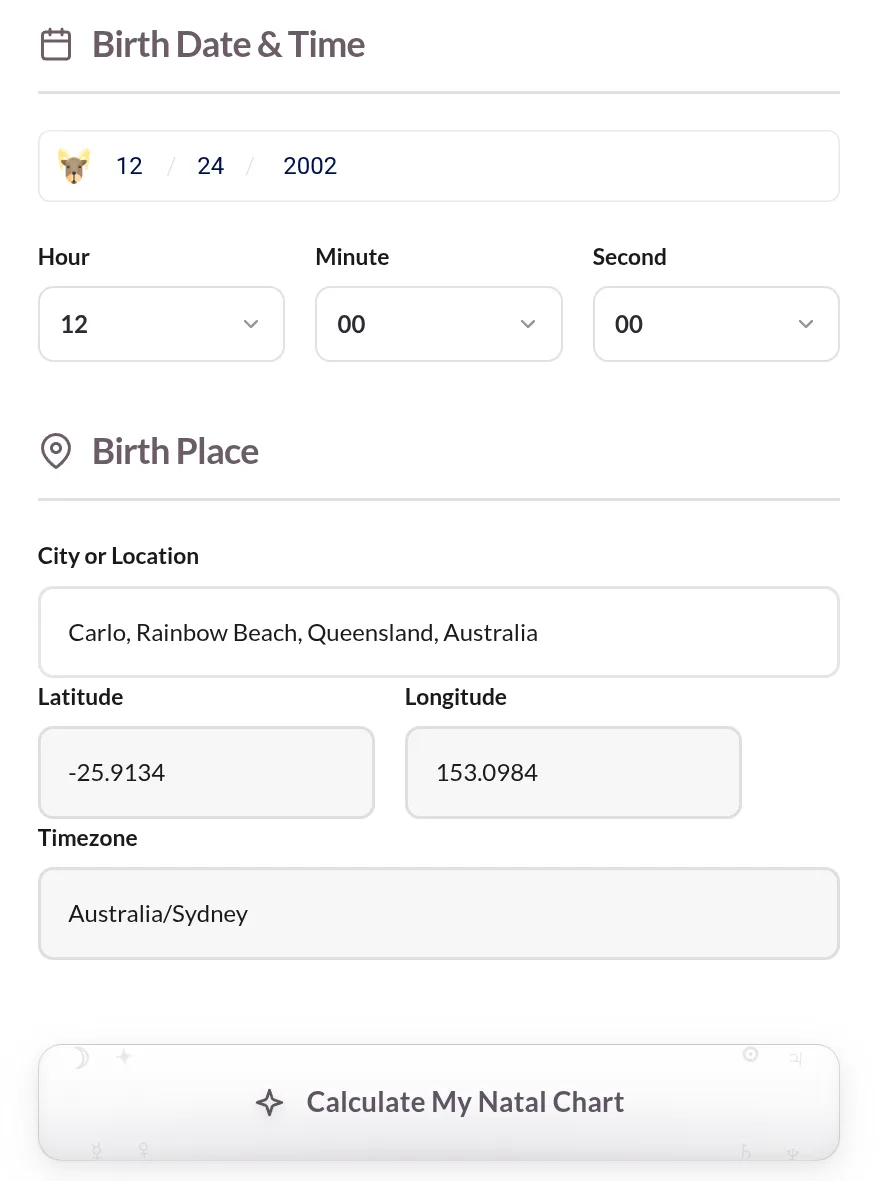
Step 1: Gather Your Birth Details
You'll need:
- Full birth date (month, day, year)
- Exact birth time (check your birth certificate or hospital records if unsure)
- Birth city and country
Step 2: Run the Free Natal Chart Calculator
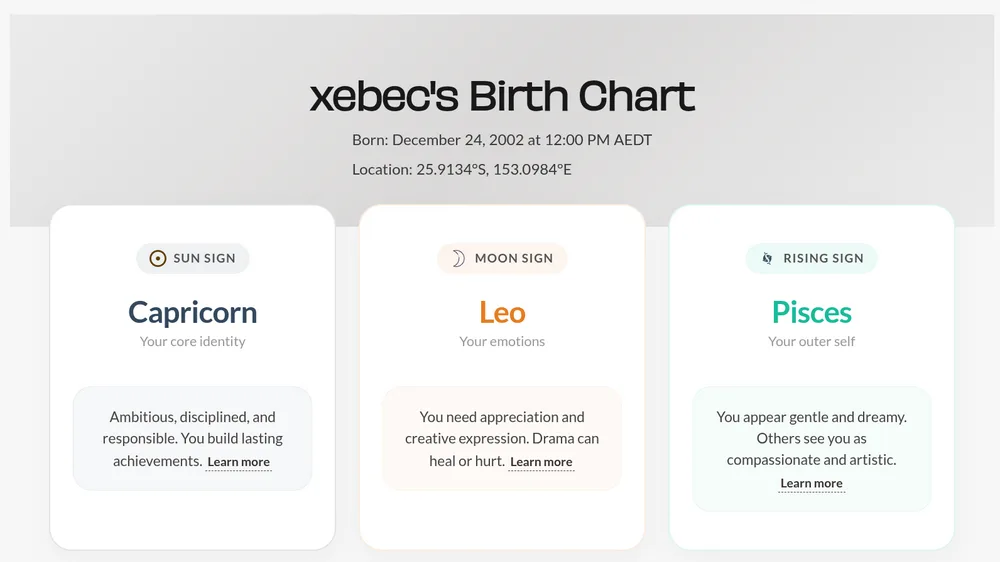
Enter your details and generate your chart. You'll receive your Sun, Moon, and Rising signs, full planetary placements, house cusps, and major aspects.
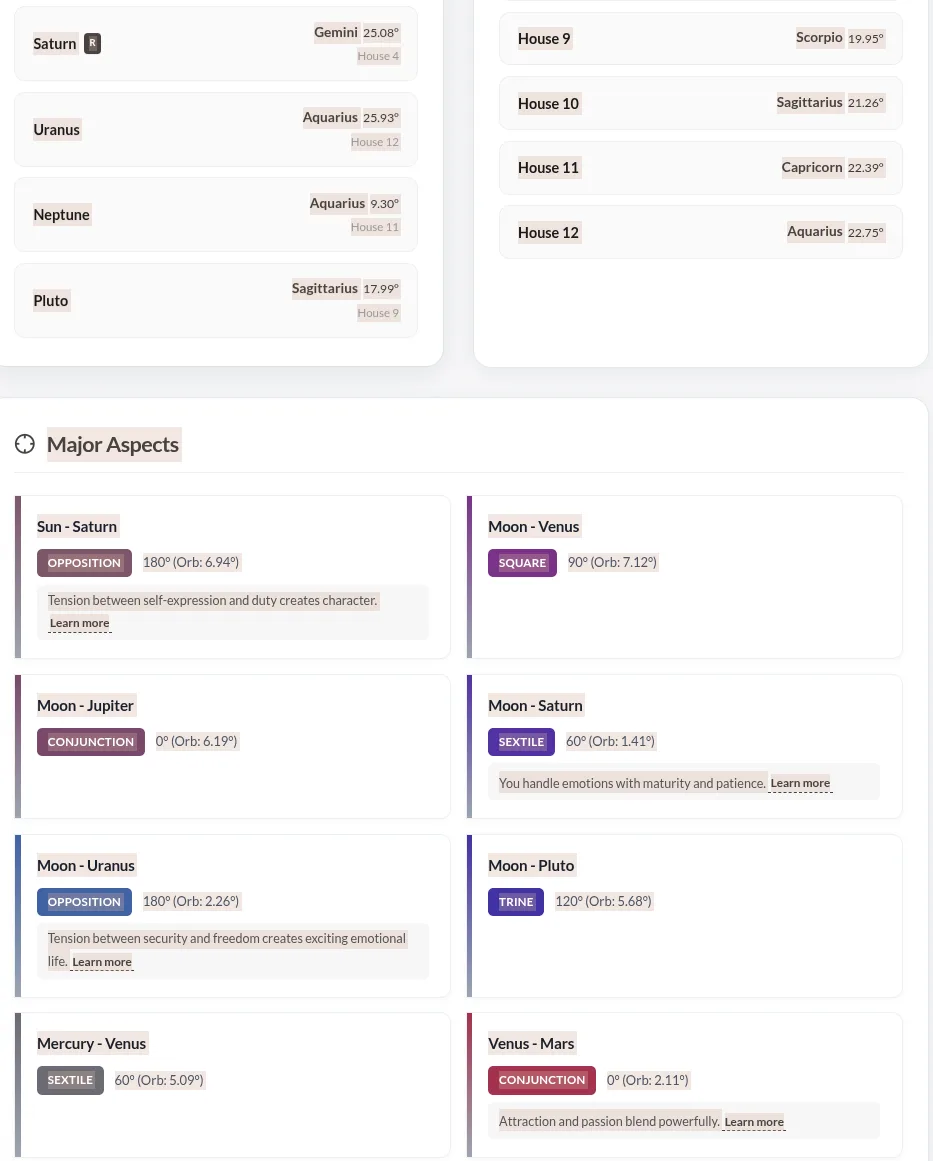
Step 3: Copy the Full Chart Output
Select and copy the complete results — not just your Sun sign. Include degrees, houses, and aspect listings if your calculator shows them.
Step 4: Open ChatGPT
Start a new conversation so old context doesn't interfere with your reading.
Step 5: Paste Your Chart Data
Paste the full results as plain text at the start of your message.
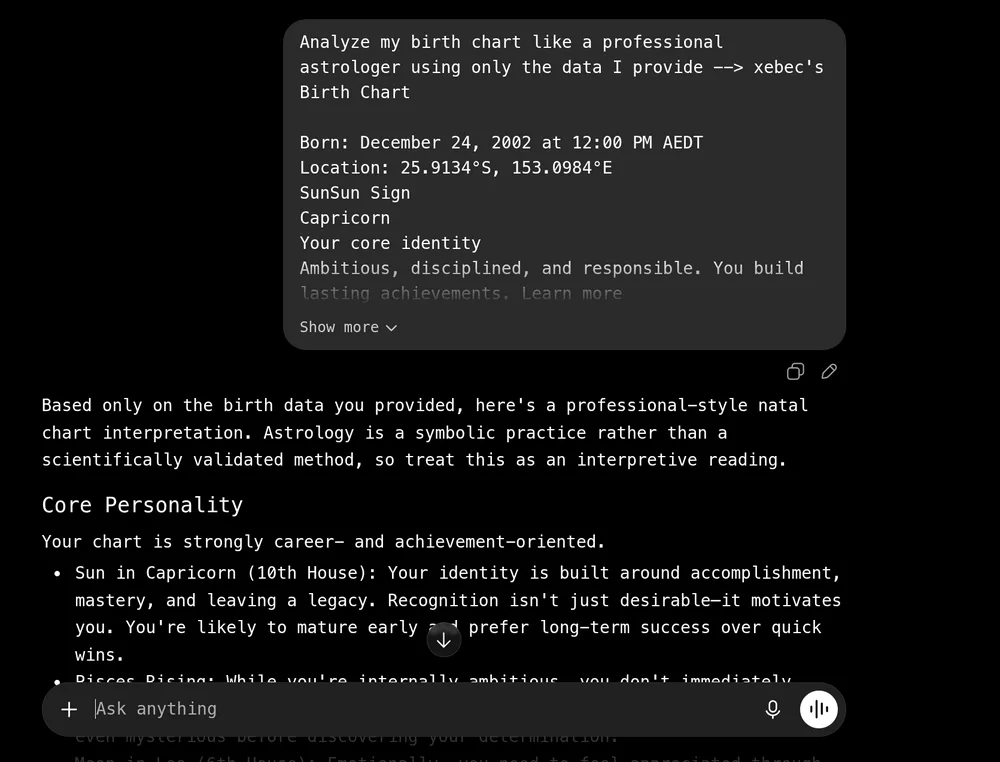
Step 6: Add a Clear, Specific Prompt
Follow the data with a request like the ones in the prompt library below — the more specific your ask, the more useful the answer.
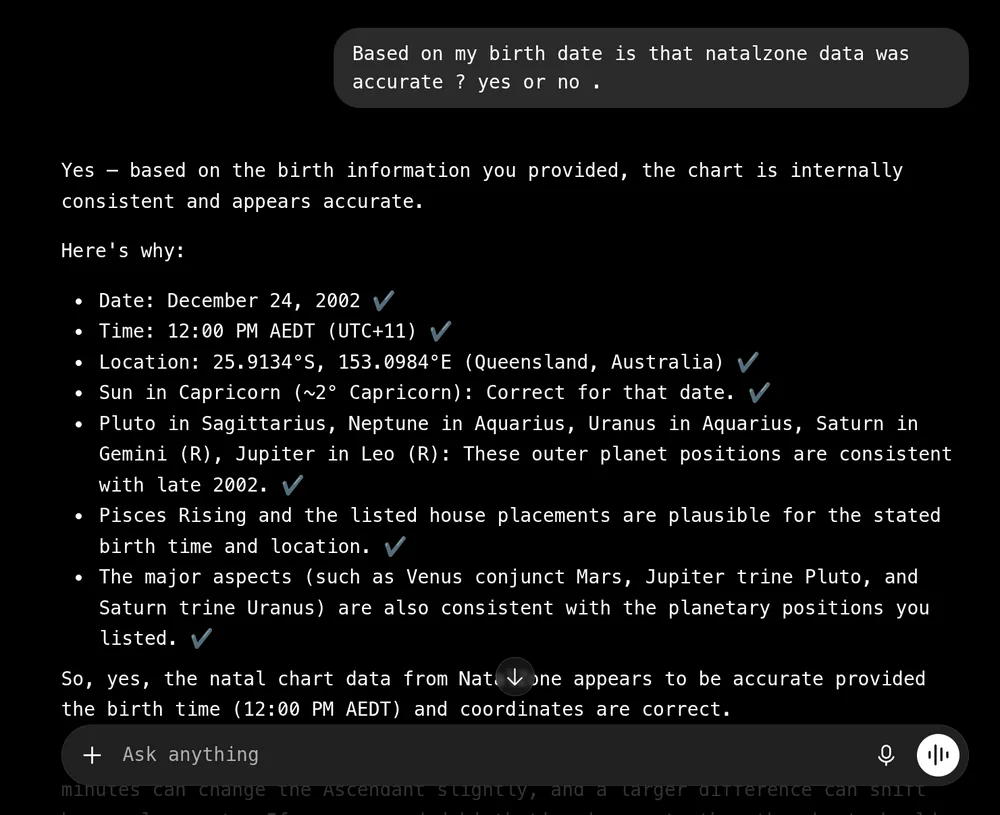
Step 7: Ask Follow-Up Questions
Treat it like a conversation, not a one-shot answer. Ask ChatGPT to go deeper on any placement that stands out to you.
Step 8: Cross-Reference With Educational Guides
Use ChatGPT's explanation alongside dedicated guides (linked at the end of this article) to build a fuller, more independent understanding of your chart over time.
Free Natal Chart Calculator vs. ChatGPT: Side-by-Side Comparison
People often assume these two tools compete with each other. They don't — they're built for completely different jobs, and understanding that difference is the whole point of this article.
| Feature | Free Natal Chart Calculator | ChatGPT |
|---|---|---|
| Calculates chart | Yes — full ephemeris-based calculation | No — cannot calculate planetary positions |
| Planet accuracy | High — based on astronomical data | Not applicable without provided data |
| Birth time support | Yes, down to the minute | Cannot process without exact time provided |
| House calculation | Yes — multiple house systems supported | No native house calculation |
| Aspect calculation | Yes — automatic aspect detection | No native aspect calculation |
| Interpretation | Basic to moderate, structured | Deep, conversational, highly detailed |
| Personalized explanation | Limited to standard chart output | Extensive, adapts to your questions |
| Beginner friendly | Very — clear visual chart wheel | Very — plain-English explanations |
| AI explanations | Not applicable | Yes — core strength |
| Accuracy | Very high for raw data | High only when given accurate raw data |
| Best use case | Generating your exact chart data | Explaining and contextualizing that data |
Bottom line: Use the calculator to get the facts. Use ChatGPT to understand what the facts mean. Skipping either step gives you half a picture.
How to Ask ChatGPT to Explain Your Birth Chart (15+ Prompts)
The quality of your reading depends heavily on the quality of your prompt. Vague prompts get vague answers. Here are prompts organized by what you're trying to learn.
General Overview Prompts
- "Here is my natal chart from a natal chart calculator: [paste data]. Please explain every placement in simple English, then summarize my personality, career strengths, relationship style, emotional patterns, biggest challenges, hidden talents, and life purpose."
- "Using this birth chart data [paste data], give me a beginner-friendly overview of my Sun, Moon, and Rising signs and how they work together."
- "Explain my birth chart as if I know nothing about astrology. Use everyday language and relatable examples: [paste data]"
Placement-Specific Prompts
- "Based on this chart [paste data], explain what my Moon sign says about my emotional needs and how I process feelings."
- "What does my Mars placement suggest about how I handle conflict and pursue goals? Here's my chart: [paste data]"
- "Explain my Venus sign and house placement in terms of how I show and receive love: [paste data]"
- "What do my Saturn placement and house suggest about my biggest life lessons and responsibilities? [paste data]"
House and Structure Prompts
- "Walk me through each of my twelve houses and what's placed in them, one at a time: [paste data]"
- "Do I have a stellium in my chart? If so, explain what it means for my personality: [paste data]"
- "What's the elemental and modality balance in my chart (fire/earth/air/water, cardinal/fixed/mutable), and what does that balance suggest about my temperament? [paste data]"
Life Theme Prompts
- "Based on my chart, what career paths or work environments would likely suit my strengths? [paste data]"
- "What does my chart suggest about my relationship patterns and compatibility needs? [paste data]"
- "Explain my North Node and South Node placements and what they suggest about my growth path this lifetime: [paste data]"
- "What might my Chiron placement reveal about a core wound and how I could turn it into a strength? [paste data]"
- "Based on my Midheaven and 10th house, what does my chart suggest about my public reputation and long-term purpose? [paste data]"
Advanced Follow-Up Prompts
- "Which three placements in my chart are most likely to define my personality, and why?"
- "Are there any challenging aspects in my chart, and how can I work with them constructively rather than seeing them as 'bad'?"
- "If you had to summarize my entire chart in one paragraph for a friend who knows nothing about astrology, what would you say?"
Pro Tip: Ask one placement at a time if you want depth, or ask for a full summary if you want a broad first impression. Both approaches work — they just serve different goals.
Common Mistakes People Make
Even with the right tools, small input errors can quietly derail an entire reading. Watch out for these.
- Guessing your birth time. "Probably around morning" isn't precise enough — the Ascendant and house cusps shift fast.
- Ignoring time zones and daylight saving time. A chart calculated in the wrong time zone can shift your entire house structure.
- Guessing your birthplace instead of using the exact city. Latitude and longitude affect house calculations directly.
- Relying on your Sun sign only. Your Sun sign is one piece of a twelve-plus-piece puzzle.
- Skipping the houses entirely. Houses tell you where in life a planet's energy shows up — skip them and you lose most of the practical detail.
- Not checking aspects. Aspects explain how placements interact; without them, a chart reads like a list instead of a story.
- Assuming ChatGPT calculated the chart itself. As covered above, ChatGPT interprets data — it doesn't generate it from a birthday alone.
- Pasting incomplete chart data. Leaving out house numbers or degrees limits how specific ChatGPT's explanation can be.
Can ChatGPT Replace an Astrologer?
Not entirely — and that's a fair, honest answer rather than a sales pitch.
Where ChatGPT genuinely helps
- Speed and accessibility. You get an explanation instantly, any time, without booking a session.
- Plain-English translation. It's excellent at converting dense astrological terminology into everyday language.
- Endless follow-up questions. You can ask it to re-explain, go deeper, or connect placements together as many times as you want, at no extra cost.
- Learning tool. It's a genuinely good way to build your own astrological literacy over time.
Where a human astrologer still has an edge
- Intuitive synthesis. Experienced astrologers often weave dozens of chart factors together in ways that reflect years of pattern recognition, not just pattern generation.
- Nuanced life context. A human can ask follow-up questions shaped by your specific circumstances, tone, and unspoken concerns in a way that feels genuinely responsive.
- Specialized techniques. Traditional methods, predictive techniques like solar returns or progressions, and certain esoteric approaches are unevenly represented in AI training data.
- Accountability and ethics. A licensed or reputable astrologer carries professional standards that an AI tool doesn't inherently have.
The most honest framing: ChatGPT is an excellent explainer and learning companion. A skilled astrologer is a synthesizer with lived experience. Many people get the most value from using both — ChatGPT for everyday understanding, and a human astrologer for deeper or more personal consultations.
Beginner Basics: Key Terms Explained
If some of the vocabulary above felt unfamiliar, here's a quick primer.
- Natal chart — a map of where every planet was in the sky at your exact birth moment and location.
- Sun sign — the zodiac sign the Sun was in when you were born; your core identity.
- Moon sign — the zodiac sign the Moon was in; your emotional inner world.
- Rising sign (Ascendant) — the zodiac sign on the eastern horizon at your birth time; your outward approach to life.
- House — one of twelve life sectors (identity, money, communication, home, and so on) that a planet's energy plays out through.
- Aspect — the angular relationship between two planets, describing how their energies interact.
- Stellium — three or more planets clustered in one sign or house.
- Element — fire, earth, air, or water; describes temperament and energy style.
- Modality — cardinal, fixed, or mutable; describes how you initiate, sustain, or adapt to change.
Frequently Asked Questions
1. Can ChatGPT explain my birth chart accurately?
Yes, as long as you provide it with accurate chart data first. ChatGPT is strong at interpretation and plain-English explanation, but it has no built-in ability to calculate planetary positions on its own. When you paste in results from a reliable natal chart calculator — including your Sun, Moon, Rising, planets, houses, and aspects — ChatGPT can synthesize that information into a genuinely useful and coherent explanation. The accuracy of the explanation is directly tied to the accuracy of the data you provide, which is why starting with a proper calculator matters more than most people realize.
2. Does ChatGPT calculate birth charts on its own?
No. ChatGPT is a language model, not an astronomical calculation engine. It doesn't have live access to ephemeris tables, and it can't independently determine your exact planetary degrees, house cusps, or aspect angles from just a birthday. If you ask it to generate a chart without providing data, it will either give you a rough Sun-sign-based approximation or explain that it needs your calculated chart data first. For real accuracy, always run your details through a dedicated natal chart calculator before involving ChatGPT.
3. What information do I need before asking ChatGPT about my chart?
At minimum, you need your exact birth date, birth time, and birth location run through a natal chart calculator. From there, gather your Sun, Moon, and Rising signs, all planetary placements with their signs and houses, and ideally your aspect list. The more complete this data set is, the more specific and useful ChatGPT's explanation will be. Partial data — like just a Sun sign — will only get you a partial, fairly generic explanation rather than a full picture of your chart.
4. Is a free natal chart calculator accurate enough?
A well-built free natal chart calculator uses the same underlying astronomical data (ephemeris tables) as paid tools, so accuracy generally comes down to whether your birth details are correct, not whether the tool is free or paid. What matters most is that the calculator uses your exact birth time, correct time zone, and precise location. As long as those three inputs are accurate, a free calculator can produce a chart that's just as precise as a professional one.
5. Why do I need my exact birth time?
Your birth time determines your rising sign and house cusps, both of which shift noticeably fast — roughly one degree every four minutes. Being off by even 15–20 minutes can shift your Ascendant into a different sign or move planets between houses entirely. Since houses describe where in life a planet's energy plays out, an inaccurate birth time can meaningfully change your entire chart's practical interpretation, even if your Sun and Moon signs stay the same.
6. What if I don't know my exact birth time?
You have a few options: check your birth certificate, ask family members, or request records from the hospital where you were born. If you truly can't find it, many calculators offer a "noon chart" as an approximation, though this will affect your rising sign and house accuracy. In this case, when asking ChatGPT for an explanation, mention that your birth time is estimated so it can appropriately caveat any house- or Ascendant-related insights.
7. Can ChatGPT read a screenshot of my birth chart wheel?
Depending on the version of ChatGPT you're using, it may be able to process an uploaded image, but text-based data is far more reliable for accurate interpretation. Chart wheels can be visually cluttered, with overlapping symbols and small text that's easy to misread. For the most accurate results, copy the text-based results from your natal chart calculator — signs, degrees, houses, and aspects — rather than relying solely on an image.
8. Is ChatGPT better than a human astrologer?
Not better — different. ChatGPT is fast, always available, and excellent at plain-English explanations you can revisit endlessly. A skilled human astrologer brings intuitive synthesis, contextual judgment, and specialized techniques built from years of experience that AI training data doesn't fully capture. Many people use both: ChatGPT for everyday learning and quick explanations, and a human astrologer for deeper, more personal consultations or major life decisions.
9. Can ChatGPT explain retrograde planets in my chart?
Yes, once it knows which of your planets were retrograde at birth. Retrograde simply means a planet appeared to move backward from Earth's perspective, and in a birth chart it often suggests that planet's energy is expressed in a more internalized or unconventional way. Make sure your natal chart calculator results indicate retrograde status (usually shown with an "R" next to the planet) so ChatGPT has accurate information to explain, rather than guessing based on general trends.
10. What's the difference between explanations of my Sun sign versus my Rising sign?
Your Sun sign explanation typically covers your core identity, ego, and the fundamental "you" underneath everything else. Your Rising sign explanation covers your outward presentation — how you come across in first impressions, your instinctive approach to new situations, and your general demeanor. People are often surprised these can feel quite different; someone can have a quietly intense Scorpio Sun with a breezy, sociable Gemini Rising, and both descriptions can feel true simultaneously.
11. Can ChatGPT explain compatibility between two birth charts (synastry)?
Yes, as long as you provide both people's chart data. Synastry compares two natal charts to look at how placements interact — for example, how one person's Venus relates to the other's Mars. Paste both sets of chart results and ask ChatGPT to compare specific placements, such as Sun-Moon compatibility or Venus-Mars dynamics. As with individual readings, the quality of the compatibility analysis depends entirely on the accuracy of both charts' underlying data.
12. How accurate is ChatGPT's general astrology knowledge?
ChatGPT's training includes a substantial amount of astrological reference material, so its knowledge of sign meanings, house themes, planetary symbolism, and aspect interpretation is generally solid and consistent with mainstream astrological tradition. Where it can vary is in more niche or traditional techniques, some predictive methods, and highly specific schools of astrological thought. For mainstream natal chart interpretation, it's a reliable and detailed explainer as long as it's working from accurate input data.
13. Is it safe to paste my birth details into ChatGPT?
Birth date, time, and location are personal but not typically classified as sensitive financial or identity data on their own. That said, if you're cautious about privacy, you can omit your birth city and simply include your calculated placements (signs, degrees, houses, aspects) instead of raw location data — ChatGPT only needs the calculated results to explain your chart, not your literal birthplace.
14. Should I use ChatGPT or a dedicated astrology app for chart reading?
They serve different purposes. A dedicated astrology app or calculator is built specifically to generate accurate chart data using proper ephemeris calculations. ChatGPT is built to interpret and explain that data conversationally. The most effective approach uses both together: the calculator for accurate data generation, and ChatGPT for flexible, personalized, plain-English interpretation and follow-up questions.
15. Can ChatGPT explain different house systems, like Placidus versus Whole Sign?
Yes, ChatGPT can explain the conceptual differences between house systems reasonably well, including how each one divides the chart differently and why certain placements might shift between systems. However, it can't calculate house cusps under a specific system itself — that calculation needs to come from your natal chart calculator, which typically lets you select your preferred house system before generating results.
16. What is a stellium, and can ChatGPT identify mine?
A stellium is a cluster of three or more planets within the same sign or house, and it tends to create a strong, concentrated theme in a chart. ChatGPT can identify a stellium and explain its significance, but only if your pasted chart data clearly lists all your planetary signs and houses. If you provide the complete placement list, ChatGPT can scan it, point out any stellium, and explain what that concentration of energy might mean for your personality and life themes.
17. Can ChatGPT explain my North Node and life purpose?
Yes. Your North Node describes a general direction of growth for this lifetime, while your South Node reflects more familiar, comfort-zone patterns you're moving away from. ChatGPT can explain both nodes in terms of sign and house meaning, and can discuss how they relate to your other placements. Just make sure your natal chart calculator results include your North and South Node positions, since not every basic chart output lists them by default.
18. Does ChatGPT know about asteroids like Chiron and Lilith?
Yes, ChatGPT is generally familiar with Chiron (the "wounded healer") and Black Moon Lilith (repressed instinct and raw authenticity), along with their common interpretive meanings by sign and house. As with all other placements, it needs the actual calculated positions from your chart to give you a personalized reading rather than a generic definition, so make sure these points are included in your calculator's output if you want them covered.
19. How do I get the most detailed explanation possible from ChatGPT?
Provide complete chart data (not just Sun sign), use a specific and structured prompt, and treat the conversation as ongoing rather than a single question. Ask ChatGPT to explain one placement at a time if you want depth, or request a full summary first and then drill into specific areas that stand out. Following up with clarifying questions — like "why does that aspect matter?" — consistently produces richer, more personalized responses than a single broad request.
20. Can ChatGPT create a visual birth chart image?
Generally, no — ChatGPT is built for text-based conversation, not for generating an accurate astronomical chart wheel with correctly placed planets and house divisions. For the visual chart itself, use a dedicated natal chart calculator, which is specifically designed to plot planets and houses correctly on a chart wheel. Then bring the text-based results into ChatGPT for the explanation portion of your reading.
21. How is asking ChatGPT to explain my chart different from just asking "what's my zodiac sign"?
Asking for your zodiac sign only addresses your Sun sign — a small fraction of your full chart. Asking ChatGPT to explain your complete birth chart, using data from a proper calculator, brings in your Moon, Rising, all planetary placements, houses, and aspects, giving you a far more layered and individualized picture. The zodiac sign question treats astrology like a horoscope column; the full chart approach treats it like the more detailed, personal system it actually is.
22. Can I ask ChatGPT to compare my chart to specific life decisions, like a career change?
Yes, and this tends to be one of the more genuinely useful applications. Once ChatGPT has your chart data, you can ask targeted questions like "does my chart suggest strengths relevant to switching into a creative career?" It will draw on relevant placements — such as your Midheaven, 10th house, and Mercury or Venus placements — to offer a perspective. Keep in mind this is a reflective tool for self-understanding, not a substitute for practical career research or professional advice.
Keep Learning: Related Guides
Understanding your chart is an ongoing process. These guides go deeper into the individual pieces covered above:
- What Is a Natal Chart?
- Sun, Moon, and Rising Signs Explained
- Birth Chart Houses Guide
- Planet Meanings in Astrology
- Zodiac Sign Meanings
- Astrology Aspects Explained
- Retrograde Planets Explained
- Why Birth Time Accuracy Matters
- Astrology Glossary for Beginners
Final Thoughts
ChatGPT can absolutely explain your birth chart — clearly, patiently, and in as much depth as you're willing to ask for. What it can't do is calculate that chart from scratch, and mixing up those two jobs is where most disappointing AI astrology experiences come from.
The fix is simple:
- Generate your real chart using our Free Natal Chart Calculator, based on your exact birth date, time, and location.
- Copy your full results — signs, houses, and aspects — into ChatGPT.
- Ask ChatGPT to explain it using a clear, specific prompt from the library above.
- Keep learning through the related guides linked above to build your own astrological literacy over time.
Start with your Free Natal Chart Calculator results, bring them into ChatGPT, and you'll get an explanation of your chart that's actually built on your real sky — not a guess.