Opening your natal chart for the first time and having absolutely no idea where to start is one of the most universal experiences in astrology. The wheel is packed with symbols, numbers, lines, and glyphs that seem to form a language only professionals can decode — but that feeling disappears the moment you know what to look at first.
Here is the truth no one tells beginners: you do not need to understand your entire natal chart on day one. You need to understand five things. These five elements give you an immediately accurate and personally meaningful portrait of who you are — far more useful than years of reading generic Sun sign horoscopes. Once you have your chart in front of you, this guide will walk you through each one in exactly the right order.
Before diving in, here are 5 things every beginner needs to know before reading their natal chart:
Generate your chart before you read this guide. You need your actual natal chart in front of you to apply what you learn here. Use our free natal chart calculator — you will need your birth date, birth time, and birth city. The whole thing takes under a minute.
Your birth time determines more than you think. Without an accurate birth time, your Rising sign and house placements will be wrong. Check your birth certificate if you are unsure. Even a one-hour error can shift your entire chart structure.
Every placement is a sentence, not a verdict. No placement in your natal chart is purely good or purely bad. Each one is a description of how energy operates in your life — and all of them can be worked with consciously.
The five things in this guide are a starting point, not the whole story. A natal chart contains dozens of layers. These five elements give you a strong, accurate foundation. Everything else you learn later will build on this base.
You will recognize yourself. That moment when a placement description matches something deeply true about you — that is the experience this guide is designed to give you. It happens for almost every beginner who reads their full chart instead of just their Sun sign.
Why Most Beginners Start in the Wrong Place
The single biggest mistake people make when they receive their natal chart for the first time is trying to read everything at once. They open the chart, see dozens of symbols scattered across a wheel, and start clicking through interpretations randomly — Sun in Virgo, then Jupiter in the 11th, then a Mars-Pluto square — without any framework for how these pieces fit together. The result is an overwhelming pile of descriptions that feel contradictory, confusing, and hard to apply.
The second most common mistake is starting with the most complicated elements first. Aspects, retrograde planets, nodes, and chart patterns are all meaningful — but they are intermediate and advanced tools. Using them before you have a solid grasp of the core elements is like trying to read a novel starting from the middle chapters. The story does not make sense yet because you do not know the characters.
The five elements in this guide are sequenced deliberately. Each one builds on the previous. By the time you reach number five, you will have a coherent, multi-layered picture of your chart — not a random collection of keywords. Start here, stay with these five, and everything else will come naturally over time.
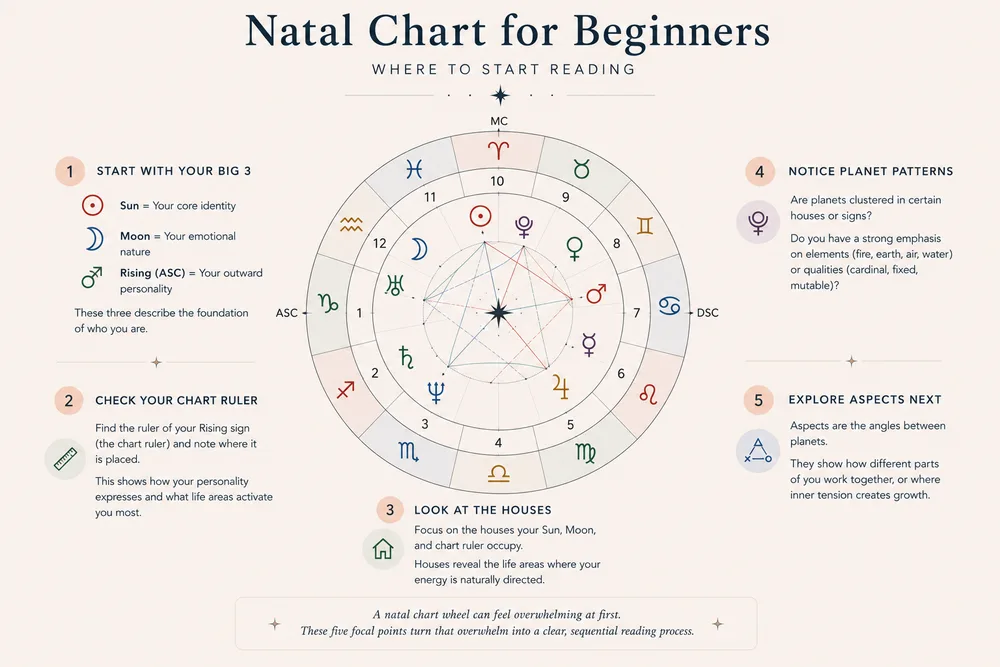 A natal chart wheel can feel overwhelming at first. These five focal points turn that overwhelm into a clear, sequential reading process.
What You Need Before You Begin
Before applying this guide, you need one thing: your natal chart generated with accurate data. Head to our natal chart calculator and enter your birth date, exact birth time, and birth city. If you genuinely do not know your birth time, enter 12:00 PM as a placeholder — but note that your Rising sign and any house-based interpretations will not be reliable.
Once your chart is generated, keep it open in another tab as you work through each of the five elements below. The goal is not to read about astrology in the abstract — it is to read your chart specifically, right now, using this guide as your map.
How Long Does It Take to Read a Natal Chart?
Your first meaningful natal chart reading — covering the five elements in this guide — takes most beginners between 30 and 60 minutes. That is not 30 minutes to understand everything astrology has to offer. It is 30 minutes to build a genuine, accurate, personally resonant foundation that will serve every future layer of learning you add on top of it. Most people find those 30 minutes more revealing than years of reading Sun sign columns.
Thing 1 — Your Rising Sign (Start Here, Not Your Sun Sign)
Almost every astrology beginner is told to start with their Sun sign. This is understandable — the Sun sign is easy to know without a chart, and it forms the basis of popular horoscopes. But for reading your actual natal chart, the Rising sign — also called the Ascendant — is where you should begin. Here is why: the Rising sign is the architectural foundation of your entire chart. It determines which zodiac sign governs each of your twelve houses, and therefore shapes how every other planet in your chart is positioned and interpreted.
Your Rising sign is the zodiac sign that was climbing above the eastern horizon at the exact moment and location you were born. It changes approximately every two hours, which is why it is the most time-sensitive and personally specific placement in your chart. Two people born on the same day in different cities — or even the same city at different hours — can have completely different Rising signs, and therefore completely different chart structures.
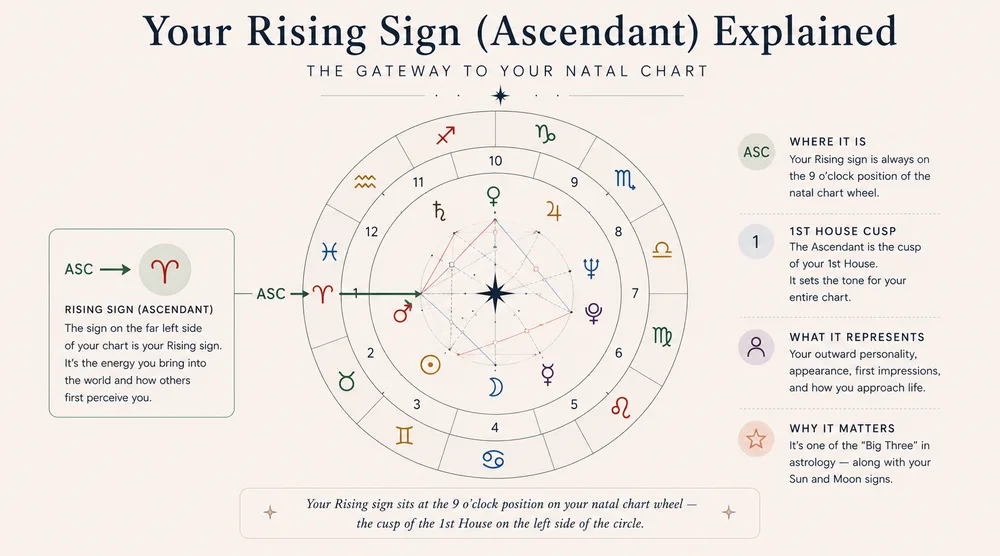 Your Rising sign sits at the 9 o'clock position on your natal chart wheel — the cusp of the 1st House on the left side of the circle.
How to Find Your Rising Sign on Your Chart
Look at the left side of your natal chart wheel — the 9 o'clock position. This is the cusp of the 1st House. The zodiac sign written or symbolized there is your Rising sign. In most chart displays, it will be clearly labeled as "ASC" or "Ascendant" with the sign name or glyph next to it.
Once you know your Rising sign, read its full description with the understanding that this is the energy you project into the world instinctively and automatically — often before your Sun sign character has a chance to emerge. Many people find their Rising sign describes how others perceive them even more accurately than how they perceive themselves.
Why the Rising Sign Matters More Than People Realize
In traditional astrology, the Rising sign was considered the most important placement in the entire chart — more significant than the Sun sign. It determines the ruler of your chart (the planet that governs your Rising sign's zodiac), the placement of all your houses, and the overall "flavor" of how your life experiences unfold.
If your Rising sign is Scorpio, for example, your entire chart is filtered through Scorpio's lens of intensity, depth, and transformation — regardless of what Sun sign you have. A Gemini Sun with a Scorpio Rising presents to the world very differently than a Gemini Sun with a Sagittarius Rising. The Sun is who you are. The Rising is how you arrive.
Thing 2 — Your Sun and Moon Signs Together
Once you have located and read your Rising sign, turn your attention to the Sun and Moon — the two luminaries of your natal chart. These three placements together — Rising, Sun, and Moon — form what astrologers call the "Big Three," and they are the single most important combination for understanding your core personality. Most experienced astrologers can give you a surprisingly accurate reading of someone's character from these three placements alone.
The reason the Sun and Moon must be read together — not separately — is that they represent two fundamentally different but equally essential parts of who you are. The Sun is your conscious self: the identity you are building, your will, your purpose, your ego. The Moon is your emotional self: your subconscious patterns, your instinctive reactions, what you need to feel safe and nurtured. One is the light you shine outward. The other is the light you carry privately inside.
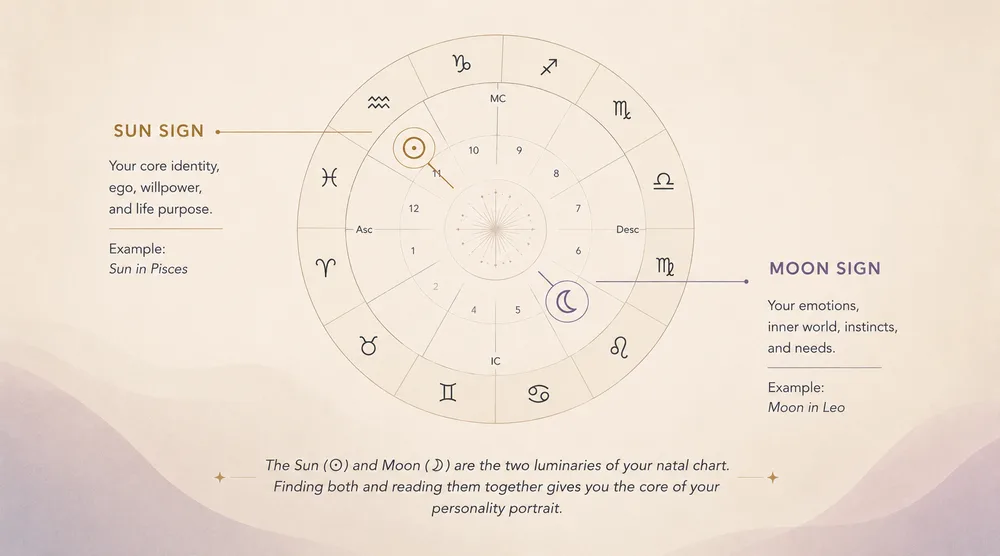 The Sun (☉) and Moon (☽) are the two luminaries of your natal chart. Finding both and reading them together gives you the core of your personality portrait.
How to Find Your Sun and Moon on Your Chart
The Sun is represented by a circle with a dot in the center (☉). The Moon is represented by a crescent (☽). Both symbols appear somewhere inside the twelve sections of your chart wheel. The zodiac sign each one sits in is that planet's sign placement. Many chart displays also list your Sun and Moon sign in a table alongside the chart wheel, making them easy to identify at a glance.
Once you know both placements, read them as a pair. If your Sun is in Aries and your Moon is in Pisces, you have a fascinating tension: a bold, action-oriented outer identity (Aries Sun) fueled by a deeply sensitive, empathetic, and emotionally porous inner world (Pisces Moon). That combination tells a very specific story about a person — one that neither placement tells alone.
When Your Sun and Moon Sign Feel Like Opposites
It is very common — almost universal — for beginners to find that their Sun and Moon signs feel contradictory. A Capricorn Sun with a Sagittarius Moon might feel torn between needing structure and security versus craving freedom and adventure. A Cancer Sun with an Aquarius Moon might feel pulled between emotional closeness and a deep need for independence.
These tensions are not problems. They are the most interesting parts of your chart. Every person contains multitudes, and the Sun-Moon combination is where that complexity is most visible. Rather than trying to resolve the tension, think of your Sun and Moon as two instruments playing different notes in the same song — the music only works because both are present.
Thing 3 — Which Houses Hold the Most Planets
After your Big Three, the next thing to examine in your natal chart is the distribution of planets across the twelve houses. This is one of the most immediately meaningful things any beginner can observe in their chart, and it requires no technical knowledge beyond knowing which number is which house. Simply look at where the planets are clustered — and where there are none.
The twelve houses each represent a different area of life: identity, money, communication, home, creativity, health, relationships, shared resources, philosophy, career, friendships, and the subconscious. When two, three, or four planets sit in the same house, that life area becomes a major focus and recurring theme in your life. The universe, so to speak, concentrated energy there — and life tends to reflect that concentration consistently.
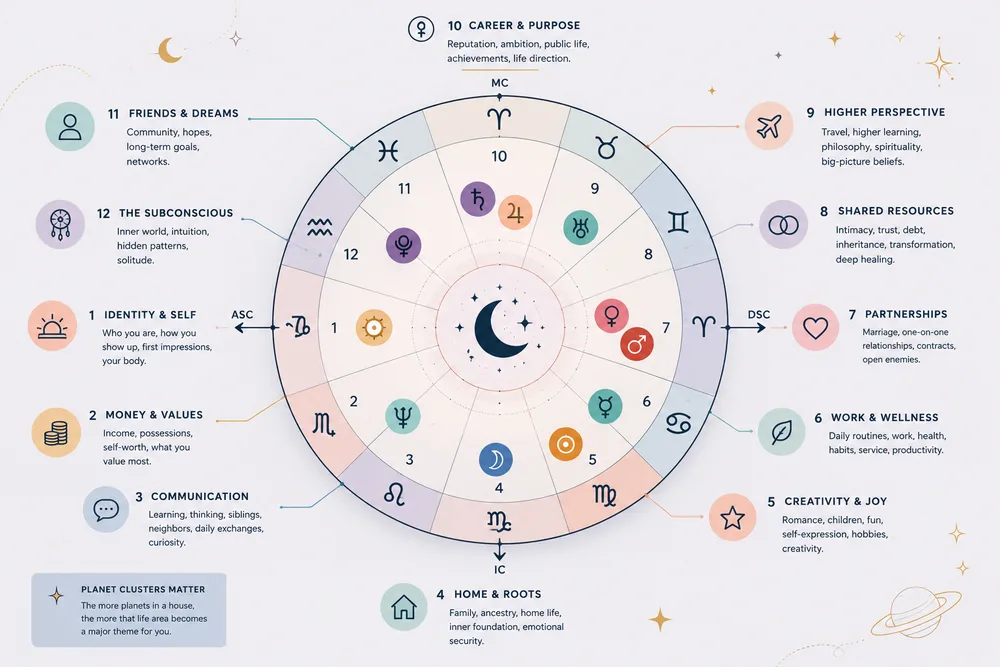 The 12 houses of the natal chart, each governing a specific life area. Planets clustered in a house signal that area as a major life theme.
What a Stellium Means in Your Chart
When three or more planets occupy the same house — or the same zodiac sign — this configuration is called a stellium. A stellium is one of the most powerful indicators in any natal chart. It concentrates the energy of multiple planetary drives into a single life area or sign expression, creating an unmistakable theme that runs through almost everything that person does.
If you have a stellium in your 7th house, relationships and partnerships will be a central, defining, and probably complex theme throughout your life. If you have a stellium in your 10th house, career, ambition, and public reputation will dominate your experience in ways that are hard to ignore. Stelliums are not inherently good or bad — they are simply zones of intensity and focus.
What Empty Houses Mean (And What They Do Not)
It is equally important to understand what empty houses do not mean. Many beginners see a house with no planets and worry that something is missing or broken in that area of life. This is a misreading. An empty house simply means that area of life is not a primary focus this lifetime — it tends to run more quietly in the background rather than demanding constant conscious attention.
You still experience the themes of every house. The house ruled by your Rising sign's planetary ruler will also activate empty houses through that ruler's placement. No area of life disappears from your experience just because no planet occupies its house. Empty houses are peaceful, not absent.
Thing 4 — Your Saturn Placement (Where You Are Being Built)
After the luminaries and house distribution, the next planet every beginner should locate is Saturn. This may surprise people who expect the fourth thing to be something more exciting — Jupiter, perhaps, or Venus. But Saturn is the planet that most directly describes the central challenge and greatest area of long-term growth in your chart, and understanding it early transforms how you interpret everything else.
Saturn in your natal chart marks the area of life where you feel the most restriction, the most self-doubt, the most pressure to prove yourself, and ultimately — if you engage with it consciously — the greatest and most durable mastery. It is the planet of discipline, structure, responsibility, and earned achievement. Where Saturn sits in your chart is where life asks the most of you. It is also, over time, where you build your most lasting and meaningful accomplishments.
How to Find Saturn and Read Its Placement
Saturn's glyph looks like a stylized lowercase h with a cross at the top (♄). Find it in your chart wheel, note which house it occupies, and then note which zodiac sign it sits in. Read the house first — that tells you which life area Saturn is activating with its demanding energy. Then read the sign — that tells you the manner in which Saturn operates in that area.
Saturn in the 2nd house in Taurus, for example, describes someone who has lifelong lessons around financial security and self-worth — who may experience material scarcity or deep insecurity about money early in life, but who, through discipline and practical effort, eventually builds extraordinary financial stability. The challenge and the gift are two sides of the same placement.
Saturn Return: Why This Placement Matters Even More at Certain Ages
Between the ages of 27 and 30, Saturn returns to the exact position it held in your natal chart. This is called your Saturn Return — one of the most significant and widely discussed astrological events in a person's life. During this period, the themes of your natal Saturn placement intensify dramatically, calling you to either step up to its demands or face the consequences of avoiding them.
Knowing your natal Saturn placement before your Saturn Return — or understanding it afterward — gives you remarkable clarity about why that period of life felt so serious, pivotal, and defining. Many people describe their late twenties as the time they finally stopped living someone else's life and started building their own. That is Saturn doing exactly what it is meant to do. Find your Saturn placement now using our free natal chart calculator.
Thing 5 — The Aspects: Lines That Connect Your Planets
The fifth and final thing beginners should look at is the web of lines drawn across the center of the natal chart wheel. These lines represent aspects — geometric angles formed between two planets that create a relationship between their energies. Aspects are what transform a natal chart from a list of isolated placements into a living, interconnected system. They are the reason why two people with the same Sun sign and Moon sign can have dramatically different personalities.
Aspects are intermediate territory in astrology, but you do not need to master them on your first reading. You simply need to recognize two things: which planets are connected by lines in your chart, and whether those lines represent ease or tension. That distinction alone — harmonious aspect versus challenging aspect — tells you a great deal about how those planetary energies work together in your life.
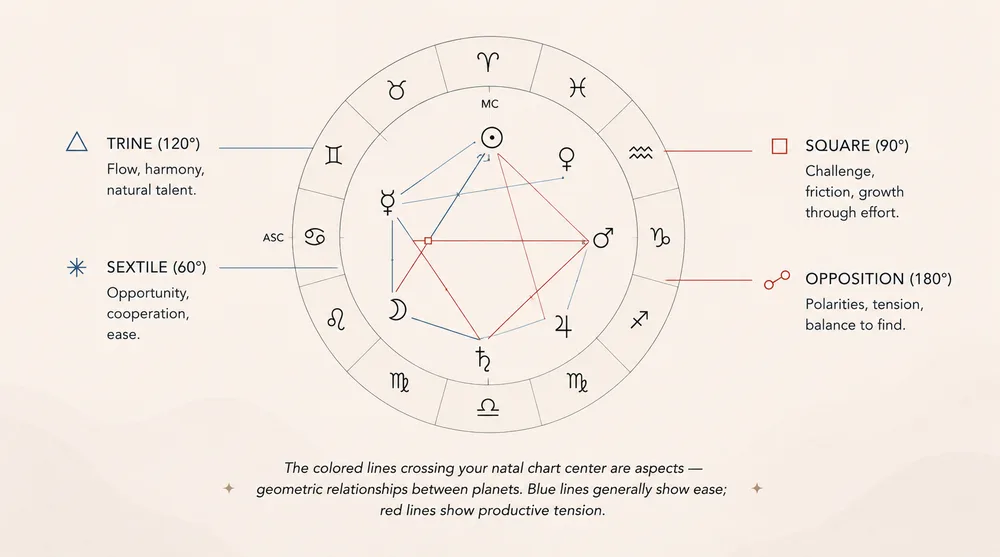 The colored lines crossing your natal chart center are aspects — geometric relationships between planets. Blue lines generally show ease; red lines show productive tension.
The Four Aspects Every Beginner Should Know
- Trine (120°) — Shown as a blue or green line connecting two planets in the same element (fire, earth, air, or water). Trines represent natural ease, flow, and talent. The energy of these two planets supports each other effortlessly. Trines are gifts — but because they come easily, they are sometimes underused or taken for granted.
- Square (90°) — Shown as a red line connecting two planets roughly three signs apart. Squares represent friction, challenge, and internal conflict. The two planets involved want incompatible things, creating tension that demands resolution. Squares are difficult — but they are also the source of tremendous drive, ambition, and growth. Many highly accomplished people have heavily squared charts.
- Opposition (180°) — Shown as a red line connecting two planets directly across the chart from each other. Oppositions represent a tug-of-war between two competing drives or areas of life. Integration is the goal — learning to honor both sides of the opposition without swinging to extremes.
- Sextile (60°) — Shown as a lighter blue line. Sextiles represent opportunity and supportive connection between planets. They are gentler than trines — the flow is available but requires a small effort to access. Think of sextiles as open doors that you still have to walk through.
How to Read Aspects Without Getting Overwhelmed
When you first look at the lines across your chart, you may see many of them — sometimes a dozen or more. Do not try to interpret every single one. Instead, focus on the planets that have the most lines connecting to them. A planet with four or five aspects is a central player in your chart's narrative — its energy is woven into many areas of your life simultaneously.
Also look for patterns. A Grand Trine — three planets connected by trines forming a triangle — suggests a major area of natural gift and ease. A T-square — two planets in opposition both squared by a third — suggests a significant area of productive tension and challenge that drives much of your life's work. These patterns will jump out at you visually once you know to look for them.
Aspects and Your Personal Story
The real power of aspects becomes clear when you connect them to what you already know from the first four elements. If your Moon (emotional needs) forms a square with Saturn (restriction and discipline), you may find emotional expression difficult or feel that your needs were consistently unmet or dismissed in early life. If your Venus (love and values) forms a trine with Jupiter (expansion and abundance), your romantic relationships tend to be characterized by generosity, growth, and mutual encouragement.
Every aspect is a sentence in your chart's story. And the more sentences you can read — starting with these five foundational elements — the more complete and personally meaningful that story becomes. Generate your free natal chart now and begin reading your own five things. The chart is already drawn. The story is waiting for you.
What to Do After You Have Read Your Five Things
Once you have worked through all five elements — Rising sign, Sun and Moon together, house distribution, Saturn, and aspects — you have something genuinely valuable: a coherent, multi-layered first reading of your natal chart. Most people are surprised by how much they recognize in themselves at this stage, even without any prior astrology knowledge. That recognition is the point.
From here, the natural next step is to go deeper into each element rather than jumping to new ones. Re-read your Rising sign description knowing now how it interacts with your Sun and Moon. Look at the specific planet that rules your Rising sign and find it in your chart — that ruling planet is especially important for you. Examine the sign and house of your chart ruler and notice how it colors the overall theme of your life path.
Planets to Explore Next: Venus, Mars, and Jupiter
After Saturn, the next three planets worth exploring in depth are Venus, Mars, and Jupiter. Venus shows how you love, what you find beautiful, and what you value most deeply — it is essential for understanding your relationship style and what genuinely satisfies you. Mars shows how you take action, how you handle conflict, and what drives your ambitions — it explains a great deal about your energy patterns and how you pursue what you want.
Jupiter shows where you expand, where luck tends to find you, and where life offers its most generous gifts. Unlike Saturn, which demands work and discipline, Jupiter operates through openness, faith, and following what genuinely excites you. Your Jupiter sign and house placement often points toward the area of life where you are most naturally abundant — though that abundance still requires you to show up and engage with it.
Deepening Your Practice: Transits and Progressions
Once your natal chart feels familiar, the next layer to explore is transits — the movement of planets through the sky today in relation to your natal chart positions. When a current planet passes over one of your natal planets or house cusps, it activates that placement and tends to trigger events or inner shifts related to that planet's themes.
Your natal chart is permanent — it never changes. But it is not static. The sky keeps moving, and those moving planets are in constant dialogue with your birth chart. Understanding transits transforms astrology from a portrait into a living practice — a way of understanding not just who you are, but why this particular moment in your life feels the way it does. Use our natal chart calculator to generate your chart and begin that conversation with the sky today.